One Star Classics

Articles

Bliss

Joe Begos Watch

/ Remi
Bliss cover

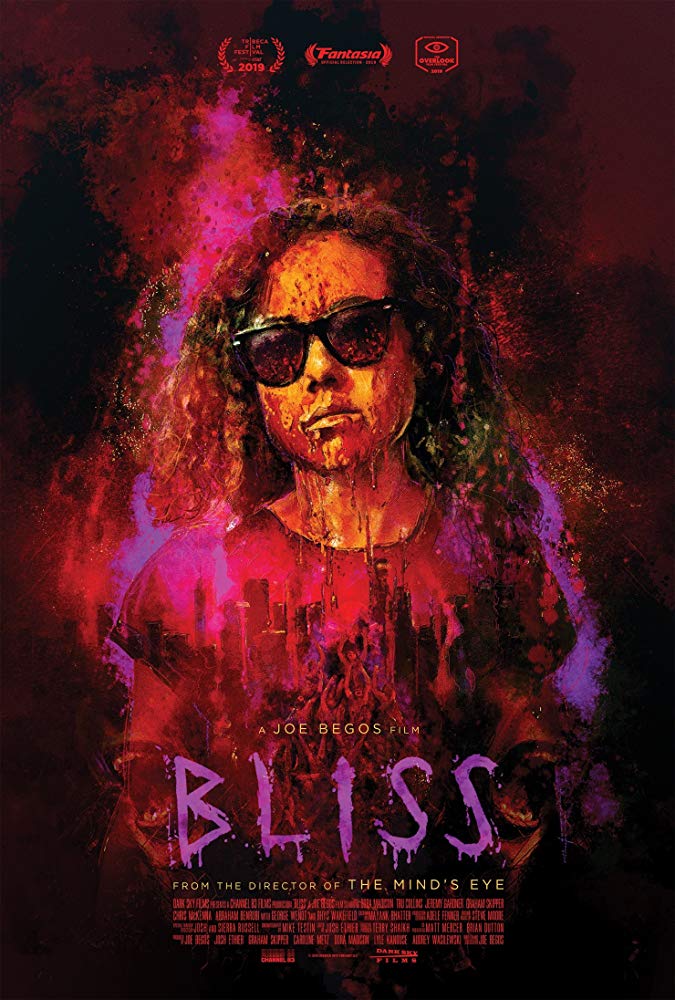
Bliss is, in all technicality, a vampire movie. I use technicality, not in the sense that the film is trying to hide its vampire-ness or to suggest that a vampire concept is bourgeois. Instead, Bliss uses the conceit as a means to present a movie which true premise is focused on creativity and addiction.

We follow Dezzy, a punk rock cover designer and artist. She has hit a creative block, and the central painting of her soon-to-open exhibition has stood untouched for three months. If she can’t finish it, her show will be canceled, and she will be out on the street.

Desperate, angry, and fed-up, Dezzy trapes to one of her old haunts, and lapses back into a drug binge after an extended period of sobriety. The substance, Bliss, hits like an intense hallucinogenic, and Dezzy descents into the darkest corners of her mind, using the lapse to re-fuel her creativity. With every nightly binge, her work turns darker, and visions of previous evenings come back to her in pieces: visions of being bit, visions of drinking blood, visions of eating someone. The realization creeps in that she has been turned into a vampire.

The vampire angle pairs well with the addiction theme, to the point where it might even be too on the nose. Cravings, blackouts, etc. – it’s somewhat predictable, yet a good fit none the less.

More importantly, Bliss does not fall victim of going the she’s happy and creative when the highs hit, dejected after route. Dezzy is miserable through each binge, the Bliss being as intense as it is numbing. Her creativity doesn’t happen because of the drugs, it happens despite them. The real tragedy of the story is that Dezzy could have created something better, had her destructive side not taken over.

Visually and sonically, Bliss mirrors Dezzy’s surreal descent. Colors and sound marry into scenes that transition fluidly from dreams to nightmares. As Dezzy slips into the darkness, the world around her turns paradoxically saturated, with strobing lights and high-pitched sounds piercing through it. It makes for both a disconcerting viewing and listening, well-matched by a hard-hitting punk rock soundtrack.

And Dora Madison as Dezzy? Rarely have I seen someone throw themselves so convincingly into a role. Her raw portrayal of anger and confusion does not let up throughout the film. It’s a performance that matches the script absolutely perfectly. Even this early on, I’m sure it will stand as one of the year’s best performances.

(Also, George Wendt is puzzlingly in the film. I do not know why, and his two minutes of screen time seems wasted.)

Bliss deep dives into a difficult and uncomfortable subject without any sugarcoating. It’s a heavy viewing for sure, but also thoroughly fascinating.
The Trailer

The Wave

Time Traveling Shenanigans

/ Remi
The Wave cover

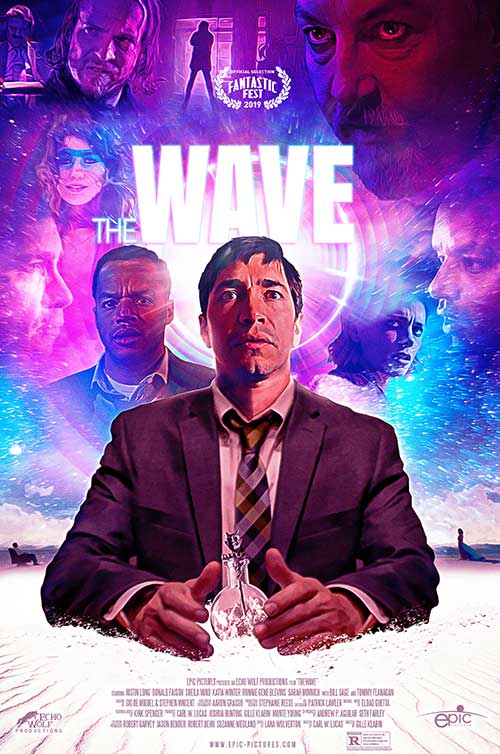
Justin Long stars in The Wave as Frank, an objectively unlikable lawyer. He is in the insurance racket, with the sole purpose of poking holes into as many claims as possible. He’s good at it, and on the night of a promotion, he goes out celebrating with his friend, Jeff (Donald Faison). One hallucinogenic trip later, and Frank’s world and its time-stream start warping. Frank finds himself bouncing back and forth in time, through situations that he, in one way or another, needs to interconnect for the time-warp to end.

It’s worth reiterating here, how much of a butt Frank actually is. It’s bad enough that he ruins lives to countless people through his work, but he’s also the type who goes out celebrating without telling his wife. To hit the trifecta, he decides to pursue one of the ladies in the bar, too.

The movie’s key goal is for Frank to find redemption, but there’s really no way for The Wave to achieve that. Ninety minutes is not nearly enough time to redeem Frank.

Yet, it’s not all bottom of the barrel, The Wave. Justin Long is a capable actor, and he does what he can with his character. Making Frank likable would be too tall of an order for anyone, but Long at least makes him seem human. It’s also nice seeing Faison again, who I mainly know as the sidekick in Scrubs. Here he holds his own as a wisecracking sidekick. Even Frank’s wife, who is scripted to be the overused nagging wife trope, is portrayed well by Sarah Minnich. The Wave might not be a trove of interesting characters, but the cast does what it can to make it seem like it is.

Too, the time-traveling was intriguing enough to hold my attention to the end. Things like what happened to Frank’s wallet, and where he stashed the drugs he stole from some murderous dealers, were questions I was able to hold out ninety minutes for the answer to. I sat through to the very end, hoping Frank’s redemption at least would be interesting.

In that sense, the time-traveling could have been worse, but the mystery of what happened during Frank’s evening is a whole lot more The Hangover than it is Primer.

And in the end, The Wave just feels banal. It doesn’t achieve saying anything, and its take on what redemption actually is is iffy at best. It never felt like Frank cared about the error of his ways; rather, he just wanted the time-warp to stop.

I don’t think a movie has to say anything particularly meaningful to be worthwhile – look no further than the Happy Death Day duology for time travel fiction that simply is entertaining. The Wave doesn’t succeed in being either fun nor profound.

With that said: the film’s final shot is gold and a reminder of Faison’s talent for deadpan deliveries.

The Trailer

Color Out of Space

Sci-fi

/ Remi
Color Out of Space cover

Like many, I have eagerly been awaiting Nic Cage’s follow-up to Mandy. The 2018 movie has cemented itself as a cult classic, largely due to Cage’s off-the-rails, yet strangely restrained performance.

In Color Out of Space (a loose adaptation of Lovecraft’s 1927 short-story), we once again see a weird and crazy Cage, though this time in a very different manner. The film is generally more accessible than Mandy, still an odd view, but not so much that it feels like an acid trip gone wrong.

We follow the Gardner family, living on a farm outside of Arkham, Massachusetts. They raise alpacas, and mom, Theresa (Joely Richardson), runs a one-person stockbroker service. One dark night, the skies light up, and a glowing purple meteorite crashes into their front-yard. Almost immediately, things go weird. Nathan (Cage) starts smelling an indecipherable stench; his daughter, Lavinia (Madeleine Arthur, bringing an all-out performance), hears painful, piercing sounds. The family members’ behavior grows increasingly bizarre, and the environment and wildlife around them start mutating.

The meteorite is, as it seems, more than meets the eye.

Nic Cage, then. Here is a performance that takes most of my post-Mandy expectations and turns them upside down. At his most normal, Nathan is downright weird; at his most insane, he seems relatively relatable. (Relatively being the operative word – it’s still Nic Cage we’re talking about.)

There are some glorious moments when Nathan is interviewed by the local news stations. His lines – which on paper seem par the course – will likely become Quotable Cage thanks to some pitch-perfect deliveries. Well, I like a bit of bourbon shouldn’t be as snort out funny as it is, nor should While the cat’s away, the mice will play. Those aren’t funny lines in themselves, but Cage injects them with a freakish sense of humor that greatly compliments the Lovecraft material.

As for the author himself, I have always enjoyed his writing, but I have not read the short story the movie is based on. I can say the film is different from Lovecraft’s general writings – the misogynist and racist parts are thankfully gone – and the plot has, judging by the short story’s summary, been stretched out and modernized. (Plus we get Tommy Chong, which is always welcomed.)

The narration is also its own beast. Lovecraft’s books tended to be told from one character’s perspective and were often built on paranoid claustrophobia. It’s probably for the best that this was ignored for the movie, as the family’s shared experiences drive the story forward in a way more suited for films. One character’s action affects another’s, which has an unintended effect on an unsuspecting animal. The dominoes fall as the family’s collective sanity deteriorates with them.

And as far as spot-the-Lovecraft-references, there is plenty to watch out for. The Necronomicon (The Book of the Dead), for example – a mainstay in Cthulhu lore – is prominently featured. These references often play into the story and serve as more than nods to the fans.

Color Out of Space is Richard Stanley’s first movie in almost twenty-five years after his disastrous The Island of Dr. Moreau (his unfair firing was documented in Lost Soul (2014)). As a comeback film, it could not be a whole lot better. The sound design and cinematography are spot-on, and the cast delivers excellent performances. It’s hard to get sci-fi/horror-pacing right, but Stanley makes it work. The action hits quickly, without feeling rushed. Color Out of Space might not be Lovecraftian in every dramaturgic aspect, but the under-your-skin building blocks are very much present.

This is about as good of a SpectreVision/Cage follow-up I could have hoped for, and Richard Stanley can fully shed the unfair tarnish his reputation suffered for decades. Color Out of Space is a great sci-fi/horror hybrid, with a handful of lighthearted moments thrown in for good measure. It’s a movie anyone and everyone could and should enjoy.

The Trailer

Daniel Isn’t Real

Mind Bender

/ Remi
Daniel Isn’t Real cover

… is he?

Luke is the product of a severely dysfunctional home-life. At an early age, he develops an imaginary friend, Daniel, which seemingly helps as a coping mechanism. They play and talk like kids do, all very innocently until Daniel’s intentions start becoming increasingly sinister. Small at first; murderous soon.

Things almost go very badly, and Luke is finally forced to lock away Daniel in a dollhouse.

Fast forward ten odd years, and Luke, having left his mother’s house for a college dorm, again finds himself in a bad place. And what better way to deal with your darkest fears than reacquainting yourself with an old friend?

With his newfound freedom, Daniel seemingly helps Luke, who loosens up and develops a social aptitude. Girls are attracted to him, and he starts doing better in school. Yet history soon starts repeating itself, and this time nobody is standing in Daniel’s way to finish his work.

Daniel Isn’t Real is at its base level a well-produced insight into a broken human psyche. When Daniel shows Luke the correct answers during a test, what we really see is Luke pulling out knowledge hidden in the back of his mind. Repeating passages from books quoted by Daniel to impress girls, shows Luke remembering what he at one time had read. Right?

Things start taking some severe twists halfway through the film, and it should surprise no-one that Daniel Isn’t Real could might as well be called Daniel Isn’t Real? What Daniel is or isn’t is something any viewer needs to figure out themselves – it certainly isn’t a straightforward conclusion to reach.

As a whole, Daniel Isn’t Real is a well-made movie. The cast, led by Miles Robbins (Luke) and Patrick Schwarzenegger (Daniel), helps bring forth a film that is equally edifying and engrossing. The story goes in many weird directions, but it never loses sight of mental illness as its core theme. The balancing act is impressive.

The film was produced by SpectreVision – an Elijah Wood joint – which has done an admirable job at delivering artisanal indie horrors as of late. Mandy was their handiwork, as is the upcoming Color Out of Space (both starring a rejuvenated Nic Cage). Daniel Isn’t Real fits well into this current canon – eclectic, yet not something that would alienate a more mainstream audience.

Daniel Isn’t Real works both as a study in psychology and as a tense, dreamlike thriller. It ranks high on my list of movies from 2019.

Schwarzenegger, Jr.

Bravo to whomever wrote Patrick Schwarzenegger’s original IMDb profile. Only recently has it been updated with the name of his father: an Austrian-born former Governor of California.

The Trailer