One Star Classics

Articles

Come to Daddy

Thriller

/ Remi
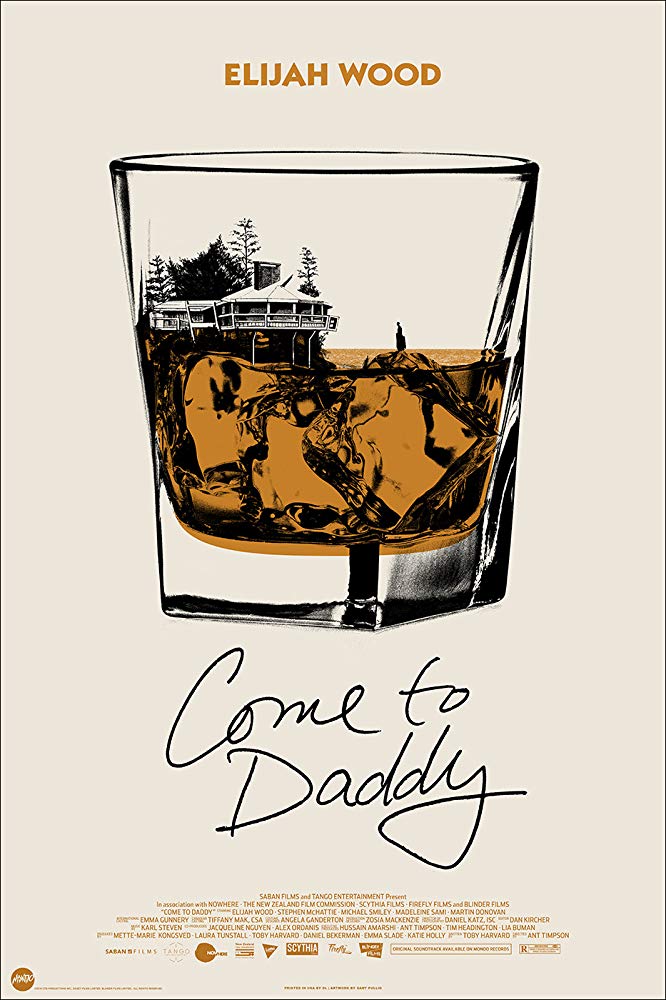
Come to Daddy cover

Norval Greenwood hasn’t seen his dad Gordon in decades. One day, much to his surprise, he receives a letter asking for a father/son reunion. Norval acquiesces and travels to Gordon’s remote house. Soon, things go weird. Gordon seems to have little interest in Norval, nor does he have any recollection of contacting him. Norval passes it off as a letter written during a drunken night, but as things get menacing, it’s apparent that something else is going on.

Elijah Wood has taken a dive into a lot of weird movies lately – not least as a producer for the can do no wrong SpectreVision company – yet Come to Daddy is almost shockingly middle of the road. The only out of the ordinary part of the film is Norval’s hair and mustache, which, seriously, bravo Elijah. It takes guts to sport anything like this.

The film, though? It’s a fairly straightforward thriller, albeit a well-made one. The cast commits one hundred and ten percent to their roles, and Stephen McHattie (who I mainly know from his memorable turn as Elaine’s psychiatrist in Seinfeld) portrays a fine villain.

There’s nothing downright wrong with the movie but Come to Daddy colors a bit too neatly within the lines for my liking. McHattie pushes his character as far as he can, but he never gets to go as all-out as he clearly is capable of. He makes the best of the more subtle scenes, like his reaction to Norval’s lie of being friends with Elton John. Pay particular attention to his poker face – if you remember the aforementioned Seinfeld episodes, you should know what to expect.

To the movie’s credit, it turns tense when things start spiraling out of control. The cat-and-mouse chase is memorable, and Come to Daddy is generally a well-executed film under the direction of Ant Timpson. It just lacks that little oomph of weird it deserves.

Give it a watch, though. In these SARS-CoV-2 days, it serves as good escapism.

The Trailer

Guns Akimbo

Action Onslaught

/ Remi
Guns Akimbo cover

Running Man meets The Purge in Guns Akimbo, an absolutely over-the-top dark action-comedy.

Daniel Radcliffe stars as Miles, a video game programmer, and semi-professional online troll. He’s an aficionado of Skizm, a real-life underground death-match series he gleefully comments on via various internet fora. Then, one day, he pisses the wrong person. The gang that runs the death-match breaks into Miles’s house and bolts guns to each of his hands. Miles is all of a sudden part of the game, pitted against a coked-up, seemingly insane Nix. They have twenty-four hours to kill or be killed.

Guns Akimbo is a bit of a fickle friend. It’s not a movie for everyone and is less of a film than a ninety-minute action scene. Even when the bullets aren’t flying, there’s an undercurrent suggesting things are about to pipe up again any second. More often than not, they do. If you’re looking for an introspective, war, what is it good for? rumination, you’re out of luck.

Because I really don’t think Guns Akimbo has too much to say about anything. It’s over the top and is in that sense sort of a satire, but it really isn’t trying to make any deep-rooted statements. Will the next level of real-world e-sports involve us watching people killing each other? I doubt it, and Guns Akimbo doesn’t seem all too concerned about giving it much thought.

From a technical standpoint, though, it does play up the video game angles impressively. Be it first-person or third-person, director Jason Lei Howden – more commonly known as a visual effects artist – nails the aesthetics and frantic nature of the medium.

The music also fits the bill, and Enis Rotthoff’s score follows the ebbs and flow of the movie faithfully. When the action kicks in on screen, it hits your ears equally hard.

Guns Akimbo is a well put together film in that sense, which probably is the primary concern a filmmaker should have when creating an over-the-top action flick. You need a true smack to the senses to get that adrenaline pumping.

Not to take anything away from the cast, mind you. It’s great to see Daniel Radcliffe make crazy role choices like this after Harry Potter, and Samara Weaving gives Nix a perfect sociopathic vibe. A cameo from Rhys Darby? That’s something any movie can benefit from.

That doesn’t change the fact that Guns Akimbo is a one-note action overkill, but it’s a note that I enjoy nonetheless. If you’re looking for a crazy adrenaline rush, Guns Akimbo definitely fits the bill.

The Trailer

Beyond the Gates

Retro Horror

/ Remi
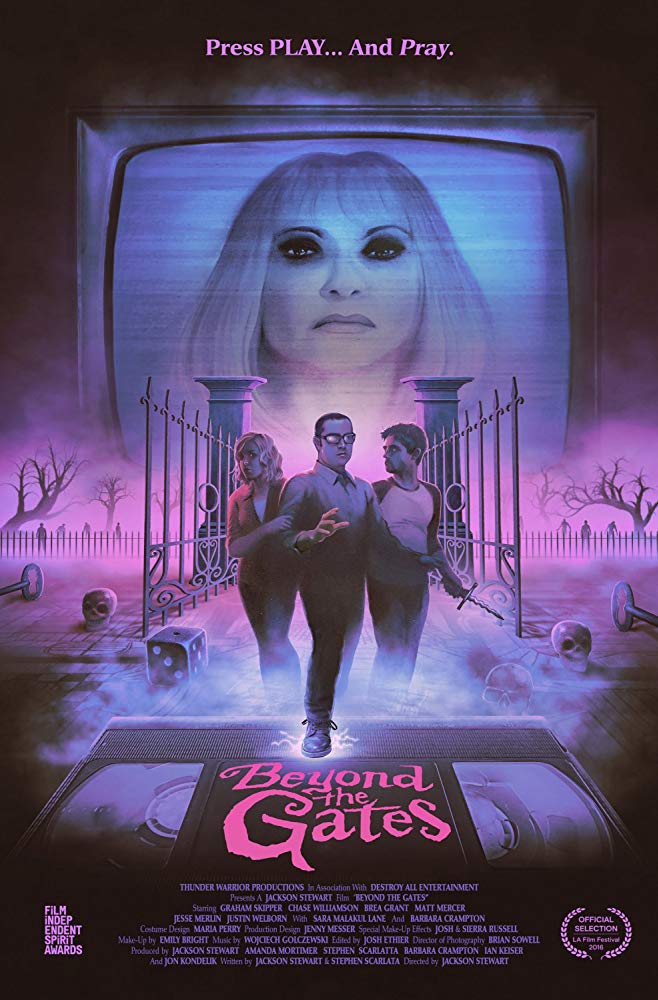
Beyond the Gates cover

Brothers Gordon and John’s father has gone missing and is presumed dead. His sons have the unenviable task of going through his possessions, which includes his old-school video store, one where he even refused to carry D.V.D.s. Yes, Beyond the Gates isn’t just a nostalgia-fest, it’s a V.H.S. nostalgia-fest.

The brothers soon find a board game with a bundled video-tape, and when they, alongside Gordon’s girlfriend, Margot, pop it in the player, things start going weird. The game-mistress is aware of who is playing the game and tells them their ultimate goal is to free their father’s soul or die trying. To reach the soul, they’ll need to travel through the gates of hell themselves.

Beyond the Gates is a bit of a mess story-wise, but its creepiness hits home effectively. The filming is pristine, shuffling from realistic, earthy tones to a restrained use of saturated blues and purples. It’s the look of what nightmares are made of. Wojciech Golczewski has put together a score reminiscent of Fabio Frizzi’s work in Lucio Fulci’s The Beyond (this movie’s principal inspiration), which bolsters an underlying feeling of dread. When it starts playing, you know something is about to happen – not a quick, sharp shock, but rather a creeping sensation.

Those are all tentpoles of Fulci’s work, and Beyond the Gates does serve well as an all-out homage to the maestro’s films. The problem is, if you’re going full Fulci, you will also inevitably have unintended oddities in your movie.

Take the character of Gordon. It is stated early on – and many times after – that he has alcohol dependency issues. But so what? The characterization has no implications on the story, so why spend time on it? It is a symptom of a more significant problem: not a whole lot happens in the initial forty-five minutes. The group watches the V.H.S., a dollop of creepiness occurs, and the brothers go back to cleaning out their dad’s video store. Rinse and repeat. I assume the intention is to show how the brothers have grown apart, but it is never played out in any way I felt emotionally connected to.

Other side-stories – like where the game was purchased – have seemingly no end-game either. Out of the eighty-four-minute runtime, only about twenty have much meat to them.

Which is too bad, because the good parts really are good. Barbara Crampton gives an eerie performance as the game-mistress, leading a cast of younger semi-unknowns that hold their own. Technically and performance-wise, Beyond the Gates is more than a solid movie. It’s the implementation of what probably sounded like good character developments that fall flat one too many times.

By all means, do give Beyond the Gates a watch if you have Hulu. It’s worth sitting through the short runtime for the good parts. Just don’t expect to be constantly entertained or enthralled.

The Trailer

The Lighthouse

Mind Bender

/ Remi
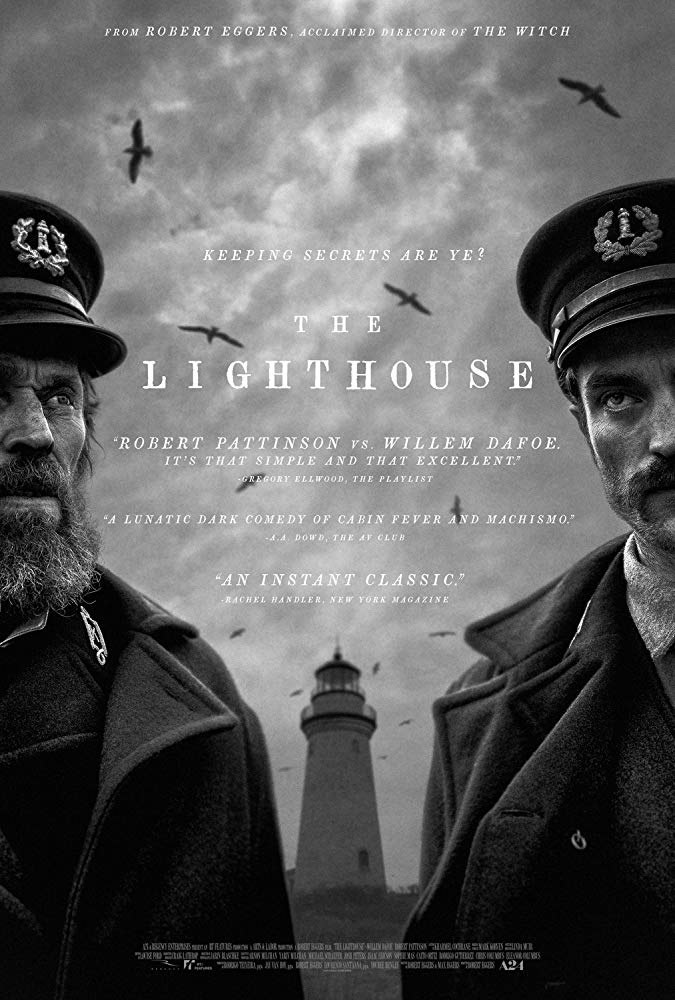
The Lighthouse cover

How long can two men be stuck with each other on an isolated island without killing each other and/or go insane? That is the question The Lighthouse posits in what is one of the more bizarre movies over the last few years.

Thomas (Willem Dafoe) is a lighthouse keeper on an island somewhere off the coast of New England, where he is joined by his new assistant, Winslow (Robert Pattinson). Thomas is a crusty keeper, salty, and adamantly insists on things being done his way. Only he is allowed to tend to the light itself.

Winslow is scheduled to spend four weeks on the island, and as a simmering mutual disdain is stoked by heavy drinking, the assistant slowly starts losing grip of reality. That is if he actually had a shred of sanity when he arrived on the island.

The Lighthouse is disorienting – the one thing an actual lighthouse is not supposed to be. Winslow starts seeing visions of merfolk, and time starts losing meaning. As he is berated and bullied by Thomas, things get – no pun intended – foggy. How long has Winslow actually been on the island? Who is out to get whom? And what makes the light so special that Thomas allows no-one near it?

It’s a strange-looking movie, too, yet gorgeous to look at; well deserved of its Academy Award nomination for best cinematography. It is filmed in a 1.19:1 aspect ratio – practically square – and 35 m.m. black and white looks appropriately eighteen-nineteens.

Too, the wind and rhythmic fog horns sound haunting, with a dull emptiness that suggests the two men stuck in a purgatory. Religion is a general theme that flows through the movie – Winslow even parallels Prometheus, the Greek titan who stole fire from the gods.

Small details are strewn throughout the dialogue, giving hints of what may or may be happening, and echoes of them can often be seen in the background. The Lighthouse is a painstakingly detailed movie.

Dafoe and Pattinson both knock it out of the park with their performances, too. They are for all intents and purposes the only actors on screen – with apologies to the mermaid – and both display an intensity that makes every scene just a little uncomfortable to watch. Their respective beard and mustache are pretty much salty characters in themselves.

It’s a complex and disorienting watch, The Lighthouse, yet constantly entertaining. I might not quite grasp what’s going on all the time, but that’s part of what makes it fascinating. It’s a well-balanced movie.

2019 was a good year for movies, and The Lighthouse ranks right up there with the best of them.

The Trailer