One Star Classics

Articles

Darling

Trippy Horror

/ Remi
Darling cover

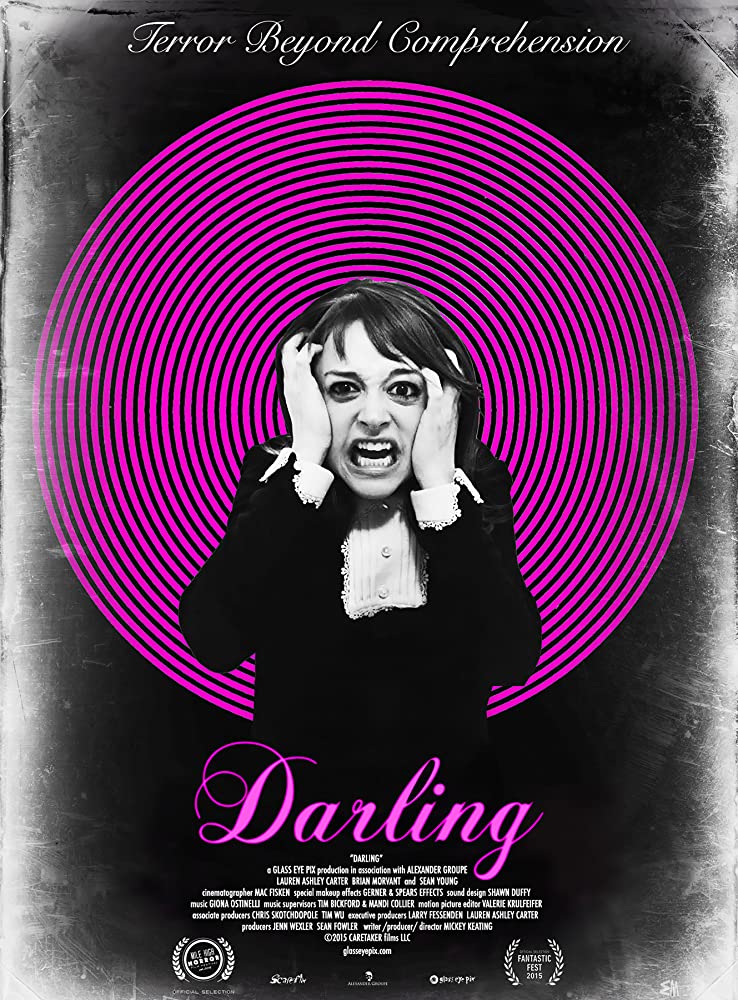
Darling is a movie delightfully full of itself. It’s the type of film that would prove anyone who finds arthouse movie making obnoxiously pretentious more correct that I’m comfortable admiring. Yet, Darling is so good at what it does, that I can forgive it for going somewhat too far in its dazzle.

We follow the titular Darling who has accepted the role as a live-in caretaker of a mansion that may or may not be haunted. Stories of occult experiments in the house run rampant around the neighborhood. Soon after moving, Darling starts having visions of violence and abuse, maybe from her past, maybe from her future, and her grips of reality start rapidly slipping.

The plot is seemingly straightforward, while the execution decidedly is not. If you’ve seen a video installation at a modern art museum, that is pretty much what you get here. There are ambient noises abound and highly stylized steadicam shots, all (of course) presented in black and white. The aesthetics are striking, with echoes of an experimental Hitchcock and sixties French cinema. It’s something a young David Lynch could have produced; maybe even an older David Lynch, going by episode eight of Twin Peaks: The Return.

There might also be a bit too much of a good thing. Even at 78 minutes, the story ends up slogging through sections of beautiful sceneries. That is too bad, as when more substantial plot points do get pushed through, they are as captivating as the slower showboating. The balance isn’t quite where it should be, and an otherwise disturbingly slow, creeping story sometimes stops in its tracks.

When it does move, it is effective, and time and place and who is who get thrown into question. At its most successful, the Darling is an unsettling story, helped well along by Lauren Ashley Carter as the titular character. (And Sean Young has a small role, too, which was a welcome surprise.)

There is a great movie somewhere inside Darling, but the visual wizardry keeps some of it locked inside. That can be exasperating, but Darling is still a very good movie. If you’re a fan of modern art and striking aesthetics, it is a must watch all the same.
The Trailer

VFW

Joe Begos Watch

/ Remi
VFW cover

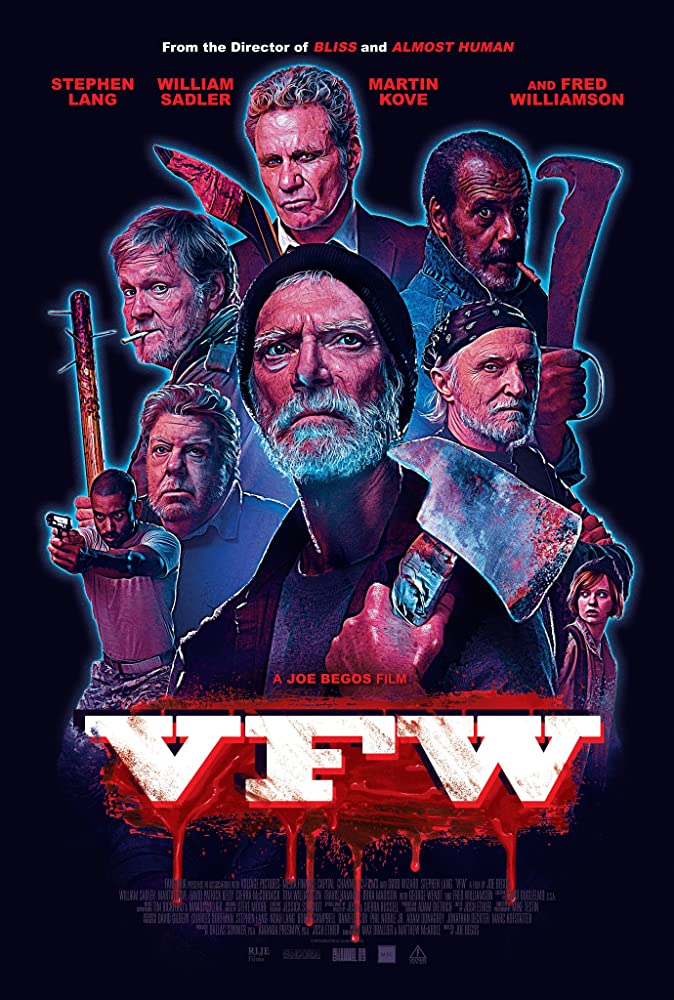
Following the trippy vampire movie Bliss, comes Joe Begos’s take on an over-the-top action story with VFW. We join Fred (Stephen Lang), who, alongside a group of fellow war veterans, is forced to defend their VFW post from a group of drug dealers. A teen girl (Sierra McCormick) has, after her sister ODed, stolen their stash and barricaded herself inside the post, hunted not just by the dealers, but also a herd of drugged-out mutants.

There are echoes of Bliss in VFW, in such that the vampires served as a loose metaphor for addicts in the former. Here, he mutants aren’t really mutants, but rather stoned-out, adrenaline-pumped human beings. In a sense, VFW is a zombie movie without zombies. Night of The Living Dead without the dead.

A large part of the team behind Bliss is back, meaning we get treated to some deeply saturated shots courtesy of DP Mike Testin and a droning synth soundtrack by Steve Moore. VFW both looks and sounds like its predecessor, though without being derivative. While the lighting is similar to its predecessor, VFW is less grungy and more dusty, which goes well in hand with the group of aging veterans. The bar might not be pretty in its deprecating state, but the red, blue, and purple hues make for a captivating scene all the same. It’s also great to see Dora Madison back after her tour-de-force performance in Bliss.

It’s a violent movie, VFW, but it also goes far enough over the top not to be taken too seriously. The borderline cyberpunk clad antagonists aren’t anything many would identify with. That’s not a bad thing, and as hoards of mutants are storming the VFW, you can sit down and enjoy the carnage without investing too many emotions into it. That’s not to say the veterans themselves aren’t likable. They are, and there is even a bit of a real feeling to their we do what we have to do to defend the young girl. Yet, this isn’t a film where you form connections on a deep level. You both come and stay for the action, and cheer for the old guys to win. It’s escapism, and that’s perfectly fine.

I’m sure VFW was shot on a B-movie budget – there basically are only two locations in the whole film – but on a technical level, it fits squarely in the A grade. Consider VFW a highly satisfying watch if you’re feeling like rooting for a pack of old veterans mowing down hoards of mutants.

Norm!

As in Bliss, George Wendt has a small role in VFW. I don’t know why, but it’s fun to see him sitting in the same spot he sat at in Cheers all the same.

The Trailer

Antrum: The Deadliest Film Ever Made

Horror

/ Remi
Antrum: The Deadliest Film Ever Made cover

In the late seventies, a film called Antrum was released upon the world in a way that is every bit as ominous as it sounds. After a few showings, every person who watched it ended up dead, and the film was lost. That is until now, when a documentary crew tracked Antrum down and is showing the whole movie as part of a documentary called Antrum: The Deadliest Film Ever Made. PS: None of this is real. Obviously.

Now Antrum, the actual feature, is a rather well-made movie. It captures the schlocky horror films from the seventies, with an obligatory VHS aesthetics and period-appropriate hair and clothes. The latter is always welcome, as too many movies of this type too often settle on a more cartoon-ish interpretation.

The plot, too, feels fitting for its era.

Nathan and his big sister Oralee are heading deep into the woods to find Antrum, the gateway to hell. Nathan’s mother has, as any good mother is wont to, told him his dead dog didn’t go to heaven because she was, and I quote, bad. I mean, wow! In the woods, the siblings hope to save the dog’s soul by using a grimoire (a book of spells) on the most unholy of spots. And as they get further into the spells from the book, disturbing things unearth, and what might have initially seemed like pretend, starts turning real.

Antrum could have held its own as a stand-alone movie. It is severely creepy at times, not with jump scares, but rather as something that creeps under your skin, to quote the preceding documentary segment. True, the history of the film adds layers, quite literally with footage that seemingly recently has been cut into the movie. There are eerie Exorcist-type overlays, some obvious, others that will be missed if you blink. In that sense, the deeper lore of a film that has changed hands over decades does add to the creep factor.

Sadly, that is also where the cookie starts to crumble.

It’s hard not to watch Antrum and wonder if this really was a long-lost movie, why didn’t anyone track down the cast, crew, or studio behind it? It is stated up front that it was a commercially released movie, and finding some actual first-hand information should have been doable.

Too, wouldn’t the people behind the documentary and restoration have been killed from watching Antrum? There is sort of an explanation for this during the end-credit documentary segment, but it is flimsy at best.

I really can’t help but feel Antrum would have been better off released as a stand-alone movie without all the gimmicks. It’s perfectly creepy and disturbing in its own right. Adding some more depth and care to the documentary segments would have been an even better scenario, but I assume budgetary constraints put the kibosh on that.

By all means, though, give Antrum a view. It is an eerie, well thought out watch, wrapped in a so-so documentary.

The Trailer

Seven Stages to Achieve Eternal Bliss

Comedy

/ Remi
Seven Stages to Achieve Eternal Bliss cover

Or to use the original title, Seven Stages to Achieve Eternal Bliss by Passing Through the Gateway Chosen by the Holy Storsh. Let’s just call it Seven Stages for short.

This movie drew my attention for two reasons: It is produced by SpectreVision – purveyors of such classics as Color Out of Space and Daniel Isn’t Real – and stars Taika Waititi. Or that was what I was lead to believe. As it turns out, Seven Stages was picked up by SpectreVision after it ran the festival circuit, and Waititi appears only in a few, memorable scenes as the deceased cult leader, Storsh.

And that is what the movie is about, too, the cult.

We follow Claire and Paul (Kate Micucci and Sam Huntington) in their new LA apartment, which soon is revealed to be the location – the bathtub specifically – of Storsh’s suicide. Thus it has become his disciples’ gateway by way of suicide to the next realm. Every night, one by one, a new member shows up to take that trip. No wonder the rent was cheap.

Claire and Paul go from being freaked out to being fascinated by Storsh’s writings and soon decide to help the cult members on their quest. From there, it goes even darker.

Of course, darkSeven Stages is, subject matter aside, not a dark movie. It’s rather a borderline absurdist comedy which sets out to do little more than throw around a few good laughs. Many times it succeeds at that. Dan Harmon makes for a likable bumbling cop, filled with ambitions of becoming a screenwriter. Maria Bamford has a brief, but memorable appearance as a cult member, as does Brian Posehn. Seven Stages is littered with who-is-who of the more absurd side of comedy.

Oddly, that is also the movie’s biggest problem. The two-paragraph plot summary above sums up most of Seven Stages, and there is little more to the ninety-minute runtime than a cavalcade of cameos. Seven Stages is a funny movie in all its individual gags, but as the one long skit it is, it gets tiresome. I’d almost recommend watching half an hour of Seven Stages a night. It’s not like you’re going to forget any plot points.

It is still a movie that should be watched, mind you. When the laughs come, they come hard. And while he’s only in it for about five minutes, Taika Waititi makes the most of every second. Micucci and Huntington tie the package together as likable protagonists, too.

Enjoy Seven Stages, much like you’d enjoy a seven-course meal. Devour it slowly and savor every bite. You don’t want to get sick of or from it after all.

The Trailer