One Star Classics

Articles

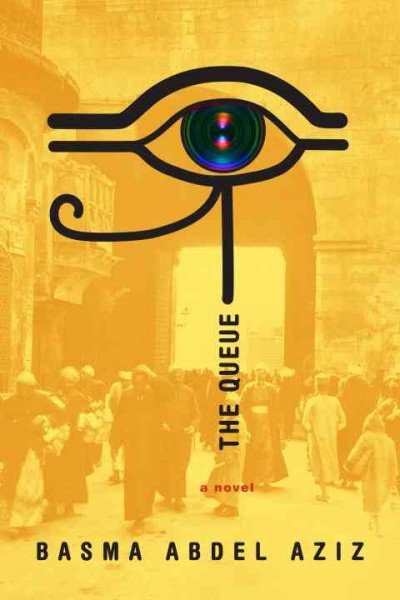
The Queue by Basma Abdel Aziz

Book

/ Remi
Thumbnail
Purchase book

I don’t know what it says about me, how I am fascinated by dystopian novels. I will gladly take the double-punch of Kafka and Huxley with Max Barry’s Lexicon as a chaser, and come away from it as the sad sack one would expect.

Personal quirks/flaws/demons aside, Basma Abdel Aziz’s take on the genre sounded different enough to interest me when I first heard of it. Aziz is a female Egypitan writer and psychiatrist, and The Queue serves as allegory of life after the Arab Spring, as well as a view of feminism in a country where the movement never flourished.

Yet you don’t have to be highfalutin and read this for political and social cocktail party discussions: The Queue is a tense, entertaining, and smart story, with a pinch of sci-fi and mystery, and slam-dunked by a mind-bending ending. More about both in a bit.

The story follows a large gallery of characters, centered around Yehya, a man who was shot during a protest against the government. If he was a protester or a bystander is a central part of the mystery, and the government would, of course, never harm its citizens. Nor would its citizens ever need to protest against it, and what actually happened gets spun any which way through the story. It’s all very Big Brother.

As «no-one» was shot, Yehya is not allowed to get the surgery he requires, unless he gets a stamp from The Gate, a governmental organization residing behind…surprise, surprise… a gate. It was closed after what was dubbed The Disgraceful Event, and thus people queue up in front of it, waiting to get stamps and permits they require to do pretty much anything.

Needless to say the queue gets very long, very soon, and with The Gate not opening… Things get grim, and a society forms around it.

There are twists and turns, and toward the last third, the story turns eerie. Yehya’s girlfriend gets caught in a situation that ends up in a scene that truly is disturbing, and by the time the (abrupt) end comes, you will question who is who, who did what, what is what, and so on and so forth.

Initially, I found the ending to be too abrupt, but seeing I have been thinking about it for more than a week and many theories have formed in my mind, I’d say Aziz nailed it pretty well.

There is a lot more to The Gate than straightforward dystopia, too, and what happened to Yehya’s girlfriend steps firmly in sci-fi territory. What is The Gate? What technologies does it sit on? How can it affect its citizens?

I love this book. It’s one of the very few I will re-read if only to understand what actually happened to whom. Reading a dystopian story from another culture—and, atypically, by a female—is interesting in itself, but that would be neither here nor there if it wasn’t well written. The Queue is very well written—and, from what I can gather, translated by Elisabeth Jaquette—and incredibly entertaining. You won’t feel as :D about it if you’re not too into infuriating endings—and I don’t blame you if you’re not—but it might still be worth checking out. If nothing else, you’ll likely appreciate the journey.

It Can’t Happen Here by Sinclair Lewis

Book

/ Remi

Sinclair Lewis called 2016 in 1935. In It Can’t Happen Here we follow the rise of Berzelius «Buzz» Windrip, a demagogue running for president using a platform built on patriotism, a return to «better» times, xenophobia, and unattainable economic promises: $5,000 payout per family, which would equal around $90,000 today. How could you not vote for this man‽

ThumbnailPurchase book.

How could you not, indeed, and vote the people did, often times with the reasoning of a status quo that needed to be shook up by an outsider.

Buzz himself appealed to the masses by telling them exactly what they wanted to hear. Drinking beer with miners he would assure them banks would face stronger regulations; during cocktails with Boston socialites an increased private control of the same banks would be promised… Buzz is a man who will tell anyone what they want to hear without having a shadow of a chance to deliver any of it.

The actual narrative centers around Doremus Jessup, a newspaper editor—write anything negative about Buzz and get shut down—trying to fight the increasingly fascist government, where power slowly gets transferred from the president to a group of Svengalis.

Disturbing as the lead-up to the election is, then, it’s what happens after that makes one, today, want to brace for what could happen in the future. Because clearly it can happen here.

I wasn’t particularly familiar with Sinclair Lewis before reading It Can’t Happen Here, only having heard of his Main Street, which was the foundation for the Nobel Prize he won in the early thirties. I’m not going to say this was the best book I ever read—it’s a bit too straightforward for my liking—but parallels to present times are chilling.

In other words, this is a timely read, one that might be a bit too depressing for some right now, but also one that could work others up in positive ways. Or both.

Either way, it’s definitely a well-written book, and it’s interesting how well Lewis nailed what the present would look like, more so than either 1984 or Brave New World.

Deliverance and Carnitas

Recipe and movie

/ Remi

Most know that infamous scene, with an unholy matrimony of hillbillies, forced pig squeals, and Ned Beatty’s unseemly underwear. Yes, it’s pretty cringe inducing, so let’s instead focus on the more impressive part of the movie: the stunts.

With a budget of $2 million, the producers had to make cuts somewhere. One might argue dumping stuntmen and foregoing production insurance would be less than an ideal solution, but that’s where they went. In the years after the movie’s release, more than 30 people have died trying to re-enact the river journey1, which suggests how insane throwing four actors into the wild Chattanooga River was.

Example: In an attempt to not kill Burt Reynolds, a stunt coordinator tried using a dummy in the actor’s place. The result was less than satisfying, and the coordinator deemed the result looking like «a canoe with a dummy in it.» On Reynolds’s own insistence, the scene was re-shot with him in it, resulting in him a breaking coccyx while being close to drowning. When asked how the scene looked, director John Boorman quipped: «like a canoe with a dummy in it».

Credit where credit is due, mind you: Actually having close-ups of the actors racing down the rapids really gave the movie a sense of realism.

Look at Jon Voight’s cliff-climb. It’d be hard for a professional to perform it, and when it looked like the actor was about to slip and fall in the movie… Well, no acting involved. One can’t help but wonder if Jared Leto would go this far in his method acting.2

The movie has received mixed reviews over the years, but it’s hard to not get caught up in the heart-pounding on-screen actions. And hey, say what you want about Burt over the last forty-odd years… Here he truly is fantastic.

The recipe: Ned Beatty Memorial Carnitas

I mean, if somebody deserves deliverance from anything, it’s Ned Beatty from pigs. So let’s once again turn to Cook’s Illustrated and their version of carnitas.

  • 1 boneless pork butt, 4 lbs, cut into 2-inch chunks
  • 1 tsp ground cumin
  • 1 small onion, peeled and halved
  • 1 teaspoon dried oregano
  • 1 lime, juiced
  • 2 cups water
  • 1 medium orange, halved

Add all ingredients into a Dutch oven, and heat it on a stove top until it simmers. Stir well.

Cover, and place in a 300 degree oven. After an hour, stir, and cook for an additional hour, until meat falls apart.

Remove from oven, and move the pork to a bowl. Discard onion and orange rinds. Place Dutch oven on high heat, and bring to boil, until liquid has reduced to about one cup.

Turn oven to broil, with the rack placed near the bottom.

Pull each piece of pork apart with two forks. Pour liquid into bowl, and add salt and pepper to taste. Place pork on a baking sheet, and broil meat for about 5 to 8 minutes on each side.

Serve, knowing Ned Beatty finally got his revenge on those damn swines.

1 And I would assume these people would have been trained outdoors types, too.

2 Actually, as an avid climber, he probably would. But you get my point.

Casablanca and Chicken Tangier

Recipe and movie

/ Remi

Casablanca should not have become the evergreen it eventually ended up being. The movie churned through three writing teams, not counting the one behind the unproduced play it was based on. After its initial release, it received only good reviews and box-office returns, and was a movie destined to be a footnote in Bergman and Bogart’s respective histories. Yet here we are, and Casablanca is arguably the best known movie of all time.

History has settled on the Epstein brothers being the sole writers of the adaptation, though Howard Koch claimed to his death that parts of his unfinished script were used. Add Casey Robinson’s unaccredited rewrite and producer Hal B. Wallis penning the famous «beginning of a beautiful friendship»-line, and you have a potpourri of a script which should be all over the map, and which was only half-way done when filming started.

Yet, somewhat ironically, the tightness of the script is what drives the film.

Casablanca isn’t particularly flashy as far as filming goes, and most of the cinematography is aimed at highlighting the sets and actors, almost theater style. The team clearly did well, seeing the audience never noticed how Bogart was two inches shorter than Bergman. One could argue how ridiculous that actually is, but at the time, it was important for Bogart to be shown as a man’s man.

The lighting is as noir-esque as the best of them, and while Casablanca doesn’t «officially» belong in the genre, I am in the camp saying it de facto does. With only hints of Rick’s past, and him being in a situation out of his control alongside a femme fatale-ish dame, it certainly walks the line.

With «La Marseillaise» and «Deutschlandlied» wailing throughout the score, the music effectively drives the story forward. And of course we have Dooley Wilson crooning us through the melodrama, almost like a narrator.

In other words, almost anything on screen is there to prop up the film’s true strength: a script as bullet-proof as they come.

I don’t know if there is much of a lesson to be learned from Casablanca, other than a tortuous writing process actually can lead to something successful. The movie is featured on most any respectable top movies of all time list. Would anybody say it was undeserved? Contrarians, maybe. Nazi sympathizers, certainly. For the rest of us, it is a movie to watch again and again—a dozen or so viewings later, and I’m still not tired of it.

Which brings us to…

The recipe!

Some have speculated the Casablanca seen in the movie actually was inspired by Tangier. I’m sure somebody who’s not me could debate that for a good long time, but I will instead present this recipe of chicken Tangier, cribbed and modified from Cook’s Illustrated.

  • 1 1/4 tsp paprika
  • 1/2 tsp ground cumin
  • 1/2 tsp ground ginger
  • 1/4 tsp cayenne
  • 1/4 tsp ground coriander
  • 1/4 tsp ground cinnamon
  • 3 2 inch lemon zest
  • 5 minced garlic cloves
  • Chicken: 4 breast pieces, 2 thighs, 2 drumsticks
  • 1 tbsp olive oil
  • 1 3/4 low sodium chicken broth
  • 1 large onion, halved and sliced 1/4 inch thick
  • 1 tbsp honey
  • 1 cup dried apricots
  • 1 cup halved pitted olives
  • 3 tbsp lemon juice
  • 2 tbsp chopped fresh cilantro

Combine the 6 first ingredients and set aside. Mince 1 strip lemon zest and combine with 1 tsp minced garlic into a fine paste. Set aside.

Season chicken with salt and pepper. Heat oil in Dutch oven over medium-high heat. Add chicken skin side down, and cook until skin is deep golden, 5 minutes. Flip chicken and brown on other side, 4 minutes. Transfer to plate, and remove skin. Discard all but 1 tbsp fat from pot.

Add onion and 2 lemon zest strips to pot, cook, stirring occasionally, until onion has started to brown. About 5 minutes. Add remaining garlic and stir for 30 seconds. Add spices and stir constantly for about a minute. Stir in broth and honey. Add thighs and drumsticks, and reduce heat to medium. Simmer for 5 minutes.

Add apricots and place chicken breasts in a single layer on top of them. Cover, reduce heat to medium-low, and simmer for 10-15 minutes, until chicken is thoroughly cooked.

Transfer chicken to plate and cover with aluminum foil. Add olives to pot, increase to medium-high, and simmer until liquid has thickened, 6 minutes. Return chicken to pot, stir in garlic mixture, lemon juice, and cilantro.

Not in the mood for chicken? This makes for a very good soup—follow the recipe, but don’t add the chicken to the pot at the end. It’ll still have a perfect chicken flavor, one Ingrid Bergman would highly approve of. (Because why wouldn’t she?!)

As an aperitif, why not imbibe a St. Germain cocktail? Two parts champagne; two parts St. Germain; one-and-a-half part sparkling water; all equals five-and-a-half parts pure class. Stir and enjoy, safe in the knowledge your messy work and laziness might one day be the basis of greatness!