
One Star Classics

Articles

The Hell House LLC duology

Found Footage

/ Remi
The Hell House LLC duology cover

I’ve never found the found footage genre too compelling. More often than not, no matter what the plot, you ’re served a shaky camera filming occasional glimpses of out of focus apparitions and incoherent yelling. The Hell House LLC duology doesn’t stray far from the formula, but, for whatever reason, both movies work up to a point.

Set in upstate New York, the story revolves around an abandoned hotel, purchased by a group of young entrepreneurs aiming to establish a haunted Halloween house. The first movie kicks off opening night when tragedy strikes, and fifteen people — including all but one staffer — die. From there out, the story focuses on a documentary crew digging into the event, aided by the surviving crew member.

Does all of this sound familiar, even if you haven’t watched the movies? Of course it does, because that is how all of these found footage films go. The only differentiator is that writer/director Stephen Cognetti sets it up a whole lot better than most.

The characters here are both likable and believable, and for the most part, they stray past the genre’s tropes du jour. They aren’t just hapless teens running around a random haunted house on a dare; instead, they are theater professionals looking to set up a legitimate business. The crew is good at its jobs, and the clown mannequins they design are creepy. When things start going down, they have a simple and believable reason to ignore them and push on: the very human threat of bankruptcy.

Both movies are creepy. I’m sure you already think you know what the deal will be with those aforementioned clowns, but the films play it smarter than that. There certainly are the expected out of focus apparitions in the background tricks, but often there are some clever twists to them. A lot of Hell House LLC’s strengths play on keeping the cards close to the chest, and Cognetti is presumably a talented poker player.

A lot of the praise heaped on the first movie can be applied to its sequel. The Abaddon Hotel, as it is dubbed, follows yet another documentary team trying to uncover what happened to the original documentary crew. Up until the last fifteen minutes, I’d say the quality holds up perfectly well. Then, as these things too often go, Cognetti tries to over-explain the last two and a half hours in a way he had little reason to do. The two movies managed not to fall too far into the found footage trap up until then, so that’s a bit of a bummer. A slow unraveling of the plot worked well for the majority of the two movies, and I question if the planned third movie will have much to offer at this point.

A disappointing ending shouldn’t keep you from watching the movies1, as the journey is a creepy one. The duology has amassed a relatively sizable cult following, and I can see why. Found footage films rarely keep me interested for too long, but Hell House LLC captivated me enough to watch the sequel.

Bonus! Read a downright tantalizing review of Mr. Jones, another rare found footage gem.

1 In fact, the only thing that might stop you from watching The Abaddon Hotel is that it’s a Shudder exclusive, but really, if you like the good things in life, you should already have Shudder in your life.
The Trailer

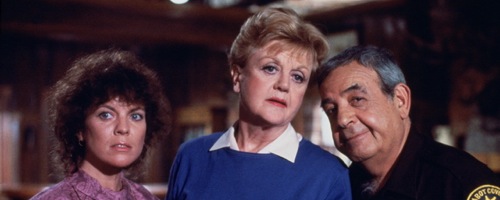
Murder, She Wrote; Mord ist ihr Hobby; Murder Is Her Hobby

By Remi

Let’s take a minute to lament how the Germans willfully shamed the great American treasure, Murder, She Wrote, or, Mord ist ihr Hobby, as it’s known there. Translated back into English: Murder Is Her Hobby. Hobby. Are we supposed to believe Jessica Fletcher just casually solved murders in her spare-time? Or is the implication that her hobby was killing people?

The Germans are walking dangerously close to libel if it’s the latter, and the only murder committed would be that of Jessica Fletcher’s character. Sure, I suppose a certain air of suspicion could be cast over the 274 or so murders that happened around the teacher-turned-crime-author, but I chalk that down to coincidence. At some point, people should have realized it was bad luck hanging around her.

Jessica Fletcher might have been guilty of many things, but that murder merely was her hobby was not one of them.
I often wondered why the cops were so reluctant to have Fletcher help them. I mean, she always solved the case.

As for the former, the fact that she solved 274—two hundred and seventy-four—murders should effectively throw out any thesis that she was just dabbling around, haphazardly doing cops’ work for them. I mean, I guess we could take this to a dark place and suggest Fletcher was running around killing people just so she would look good when she solved the crimes, sending innocent people to death sentences—we never really see any of this going to trial—but I refuse to degrade Ms. Fletcher to having been a narcissistic sociopath. Not a court in the country would convict her on such circumstantial evidence as tossing out, Oh, but this was no accident. No, this was murder, with a titch too much confidence.

No, Jessica Fletcher was wronged by the Germans, there is no doubt about that. Whatever Ms. Fletcher may or may not have done could have been many things, but a trivial hobby it was not. It makes one question how these people wronged Diagnosis: Murder.

The Vault

Horror-ish Thriller

/ Remi
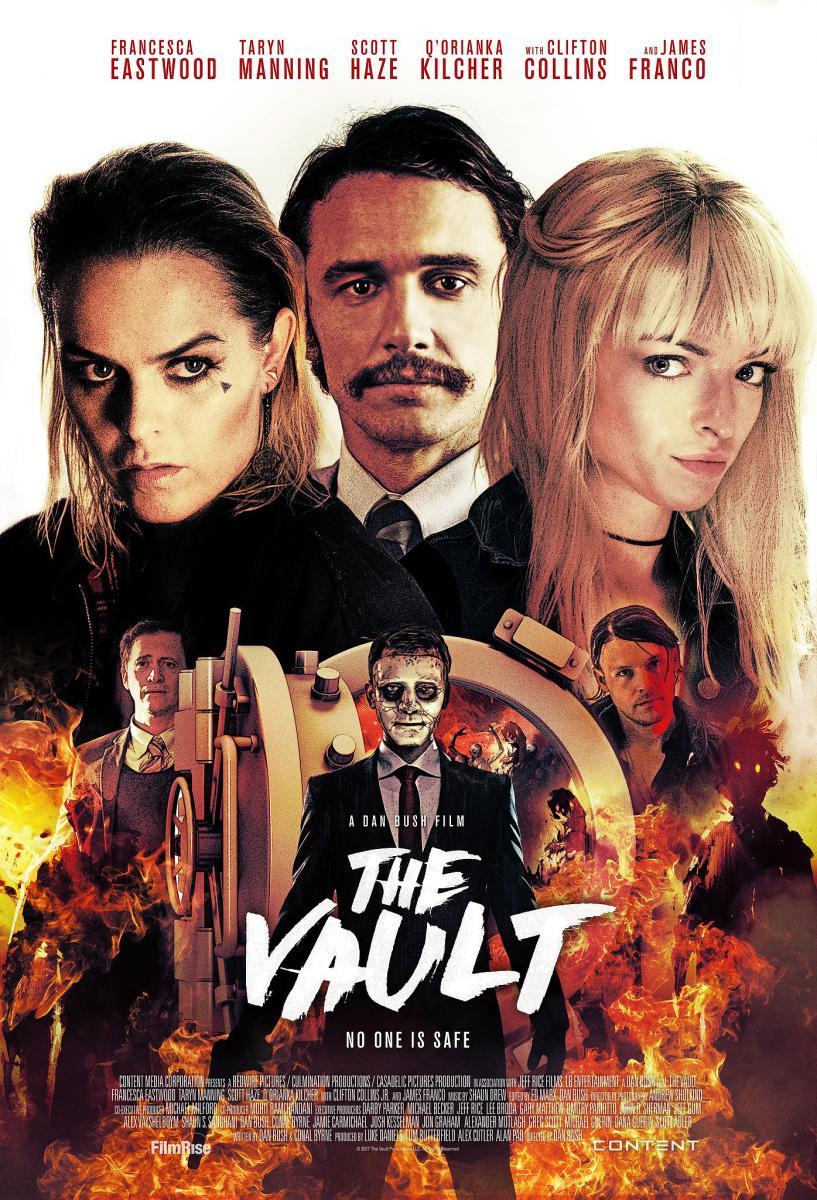
The Vault cover

The Vault is not a great movie. Whether it’s the technical aspect or the dramaturgical flow, it does not live up to a clever supernatural, heist-gone-wrong concept.

You know the drill: A group of ne’er-do-wells attempt a caper, hostages are taken, cops arrive, everybody is trapped, and so on, and so forth.

But here’s the twist: The robbers learn from an assistant manager — James Franco, donning a ’stache for the ages — that the basement vault holds a vast cash reserve. The haunted basement.

It’s slock in a Tales from the Crypt kind of way. The backstory of victims from a botched 1982 robbery haunting the bank, that whole thing. Lessons will be learned. Conceptually, I find it entertaining.

It’s the execution that leaves something — a lot — to be desired.

First, Franco. It’s painfully apparent his scenes were filmed separately from the rest of the cast. His performance mostly consists of sitting in a corner, looking nervously at the surveillance videos. Only a handful of times do we see him interact with other actors. It’s jarring.

Threads go unresolved, and I don’t mean that in the artistic sense. Rather, the writers and director seem to have forgotten about them. The story of what happened in ’82 is hastily laid out, without the details needed to set up present event, particularly related to one key character.

As for the twist ending, which is set up in one of the earliest scenes, it’s something you’ll have figured out before you even know there will be a twist. It’s bizarre, but it’s all but spelled out in the opening credits, and when paired with the final scene, it’s like you’ve watched two different movies combined into one. I’m still not sure if a caper film and a horror movie were hastily edited together, with a few additional scenes added as glue.

On the positive side, Taryn Manning (you know her as Pennsatucky in Orange Is The New Black), and Francesca Eastwood (not no relations) are stand-outs as off-kilter sisters who are in over their heads. The man in the white mask, too, is appropriately creepy.

It could have been a Tales from the Crypt homage of some class, but The Vault doesn’t bring home the bacon. Entertaining to a point, but it should have been so much more.

The Trailer

Infinity Chamber

Sci-fi

/ Remi
Infinity Chamber cover

Minor spoilers below, in case you’re persnickety about those kinds of things. (And no, I have no clue what the tagline has to do with the movie.)

Here’s a movie I had expected to jot down as a guilty pleasure, yet found to be very good in its own right. Infinity Chamber is sci-fi for those who like the more grounded variety of the genre, one that at least seems somewhat plausible within its boundaries.

In a near dystopian future, we find Frank gazing at a photo, as two government agents storm in, stun-gunning him down. In an eponymous chamber, Frank wakes up finding his only companion to be Howard, a HAL-like AI. On the surface, Howard’s job is to keep Frank alive. For what reason? To access his dreams.

For Frank to sleep soundly, Howard provides him with (grubby) food and (disgusting) drinks. A selection of classical music pipes through the room to soothe him. His dream is always the same: Memories of his final day of freedom, from which the totalitarian regime wants to extract… something. Exactly what and why is unclear.

The questions amass. Is Howard really an AI? Who is Frank? Are we seeing his dreams? Are the dreams actually dreams, or is the perceived reality the dream? Who is the dreamer? Hints are strewn about, and interpretations are entirely subjective. Odds of catching everything in one viewing are minimal at best.

I like dystopian sci-fi, and Infinity Chamber scores well in that genre. It’s clear the ambition for the movie was more extensive than the budget — multiple scenes were filmed in writer/director Travis Milloy’s house — but creative tricks and an excellent performance from Christopher Kelly go a long way making up for it. Jesse Arrow’s does a fantastic job as Howard’s voice, too.

The internet is abuzz about the ending, with little to no consensus of what it means. In my mind, Infinity Chamber needs to be re-watched with a completely open mind, confirmation bias thrown to the wayside. I did notice some obvious hints of what it all did not mean, but I would lie if I claimed to understand where the movie landed. To me, it seemed like at a dark place. Many disagree. Others say the ending is inconsequential.

My point is that this is a movie you need to pay attention to if you want to enjoy the ride. Spotting the hints is a lot of fun. In some sense, the film reminds me a bit of the original Cube as far as the dystopian aspects go, though Infinity Chamber is executed better with its slick presentation.

Give it a view. It deserves it, and so do you.

The Trailer